Running a small candle business means making packaging decisions with limited budget, limited storage, and very limited margin for error. You cannot afford to lock up cash in 3,000 units of packaging that misses the mark, but you also cannot afford to look cheap when a buyer at a boutique or a customer on your Shopify store is evaluating whether to spend $35 on your candle.
This guide is written specifically for small candle makers, one-to-five person operations, and growing DTC brands. The goal is to give you a clear set of packaging ideas that actually work at smaller scales, with honest trade-offs for each.
Start With Your Sales Channel
The single most important packaging variable for a small business is where your candles actually sell. Packaging that works beautifully on a retail shelf performs differently in a shipping box. Packaging designed for a subscription fulfillment center has completely different structural requirements than a display piece for a craft fair.
Before you spec out any packaging, answer these three questions:
- Where does the customer first encounter the packaged product? (Online photo, retail shelf, gift table at a market?)
- How does the product travel from you to the customer? (Direct mail, wholesale retail delivery, hand-carried?)
- What is the customer doing with the packaging after they receive it? (Gifting it, discarding it, keeping it?)
The answers shape everything. A candle sold primarily through Instagram and shipped DTC needs durable, print-rich candle shipping boxes that create a great unboxing moment when the package arrives. A candle sold through a boutique needs retail shelf presence, not shipping performance. A candle positioned as a gift needs an enclosure the recipient feels good receiving.
Low-Commitment Starting Points
If you are in early stages, launching a new SKU, or validating a market before committing to larger quantities, here are the packaging approaches that make the most financial sense.
Kraft Tuck-Top Boxes With a Single-Color or Two-Color Print
Kraft board with a clean single or two-color design is one of the most cost-effective starting points in candle packaging. It reads as intentional and artisan without a large print budget. The earthy, uncoated look has become a genuine brand signal for small-batch makers, so it tends to resonate well with buyers who appreciate craft over mass-market polish.
Kraft candle boxes work particularly well for natural-oriented brands, soy-free or beeswax candles, outdoor and botanical scent profiles, and any brand that wants to communicate that something real and human made this product.
The limitation is color fidelity. The brown base of kraft paper absorbs color differently than white stock, so very light colors (pastel pink, cream, powder blue) will not reproduce cleanly without a white ink undercoat, which adds cost and complexity.
White Coated Cardboard With Full-Color Print
White coated cardboard gives you clean, full-color printing at a very accessible price point. This is the most flexible option for small businesses because it does not limit your color palette, it ships flat before assembly, and it performs well at quantities starting at 100 units.
For a small business, the smart move is often a clean white base with a single design that does your brand justice at your current SKU count, then evolve to differentiated designs per scent family or product line as volume grows.
Printed Mailer Boxes for DTC and Subscription
If you sell primarily online, a printed corrugated mailer box is often the highest-leverage packaging investment you can make. It replaces both the inner retail box and the outer shipping carton. It creates an unboxing moment. And it is durable enough to protect a glass candle vessel through standard carrier handling.
Candle subscription boxes and direct-to-consumer brands get the most out of corrugated mailers. The corrugated structure also gives you extra interior surface area for brand messaging, care instructions, and product storytelling.
Standing Out at Retail
If your candles go into gift shops, boutiques, florists, home goods stores, or any physical retail environment, shelf presence is the job your packaging has to do above everything else. Here is how small brands create standout presence without a large packaging budget.
Use Negative Space Deliberately
Many small business candle brands make the mistake of trying to include too much on their box. A small or mid-size box has maybe four or five inches of printable height and eight to twelve inches of perimeter. Crowding that space with scent notes, ingredient lists, social handles, care instructions, and decorative elements produces a package that looks busy and cheap.
Professional packaging designers use negative space as a design element. A large, clean logo on a well-chosen background color, with one or two lines of supporting copy, tends to read better at shelf distance than a box full of information. The information can live on a card insert or on the underside of the box.
Invest in One Premium Finish
For a small business, adding a premium finish to every SKU across your full line is expensive. A more practical approach is to choose one finish upgrade and apply it to your most important product, usually your highest-margin or highest-visibility SKU.
Matte lamination with spot UV on the logo is one of the most impactful low-cost upgrades available. The matte base gives the box a premium, understated feel. The spot UV makes your logo pop with gloss contrast without printing the whole box in gloss. Total cost premium over standard print is modest, and the perceived quality lift is significant.
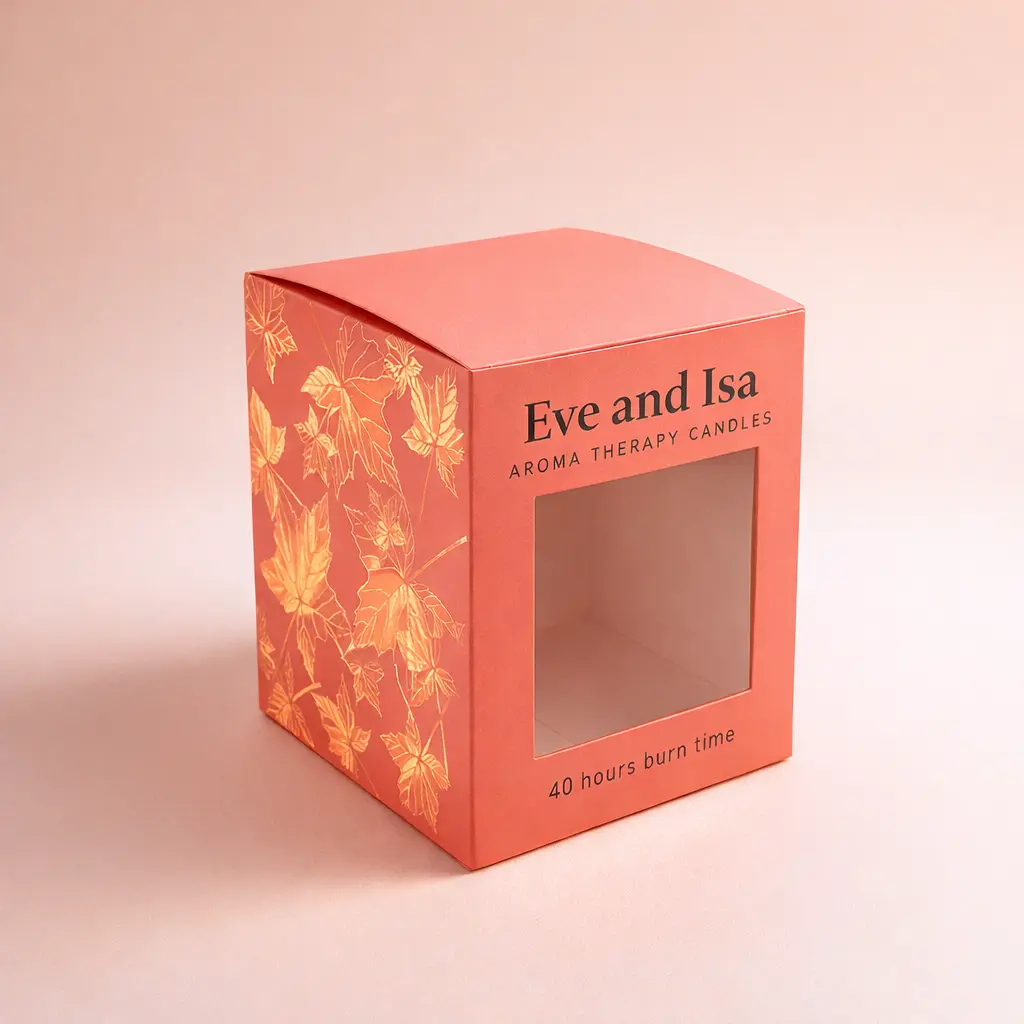
Foil stamping is another option worth considering for luxury candle boxes or premium gift lines. Gold or silver foil on a simple logo or botanical motif communicates luxury in a way that ink printing alone cannot. For a small business, apply it selectively rather than as a blanket treatment.
Pick Colors That Photograph Well
A meaningful percentage of candle retail now happens through photography. Your product is on your website, your Instagram, your wholesale platform, and your stockists’ social feeds. Packaging that photographs well is packaging that sells.
Colors that work well in photography: deep jewel tones (forest green, navy, burgundy), warm neutrals (cream, terracotta, sand), black and white, rich earth tones.
Colors that are harder to photograph well: very pale pastels without strong contrast, metallics without texture variation, and very bright saturated colors that tend to blow out under product photography lighting.
If you are early in your brand development, prototype a few packaging colors and photograph them before committing to a print run. A printed sample of your design on the right substrate will tell you far more than a screen mockup.
Gift Packaging for Small Candle Businesses
Gift packaging is a separate opportunity from standard retail or DTC. If your candles sell as gifts, the packaging needs to do more work. It needs to feel complete as a gift on its own, without the buyer needing to wrap it or add anything.
Two-Candle and Three-Candle Gift Sets
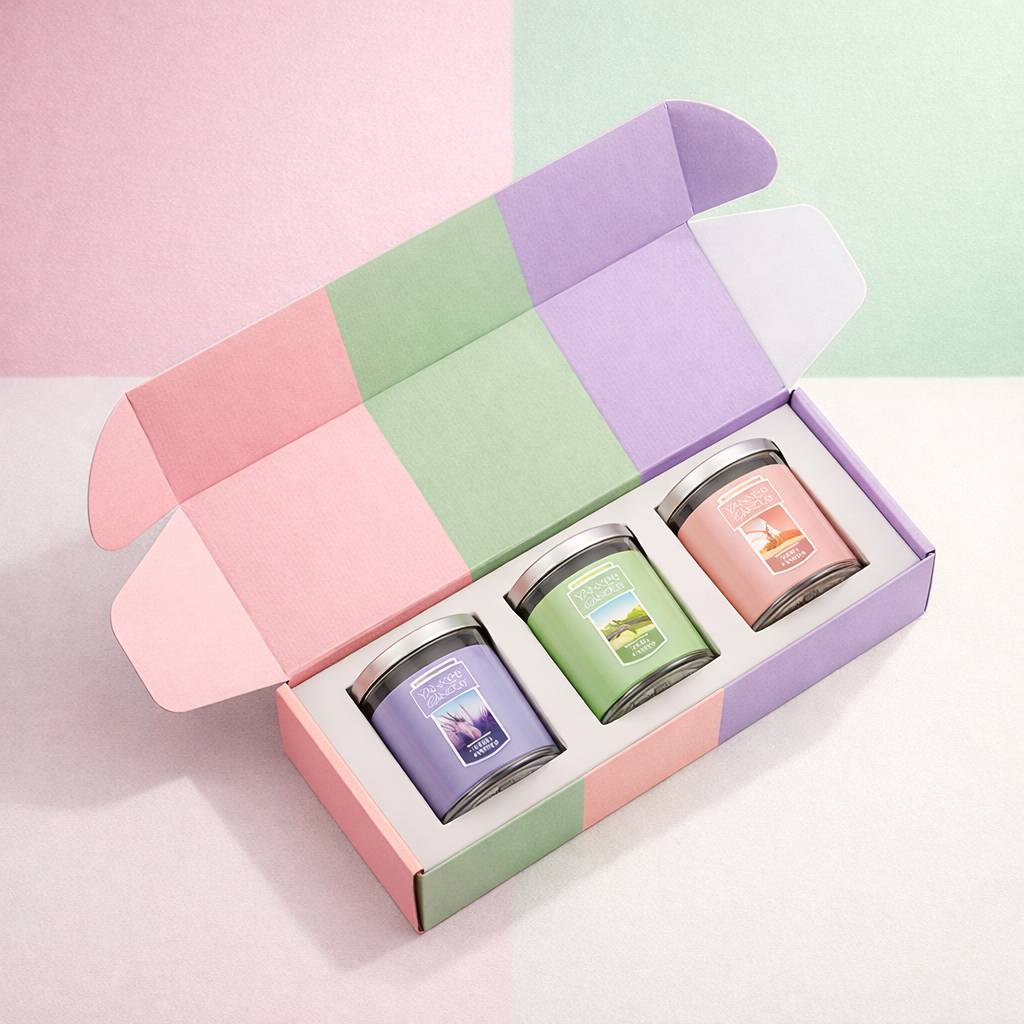
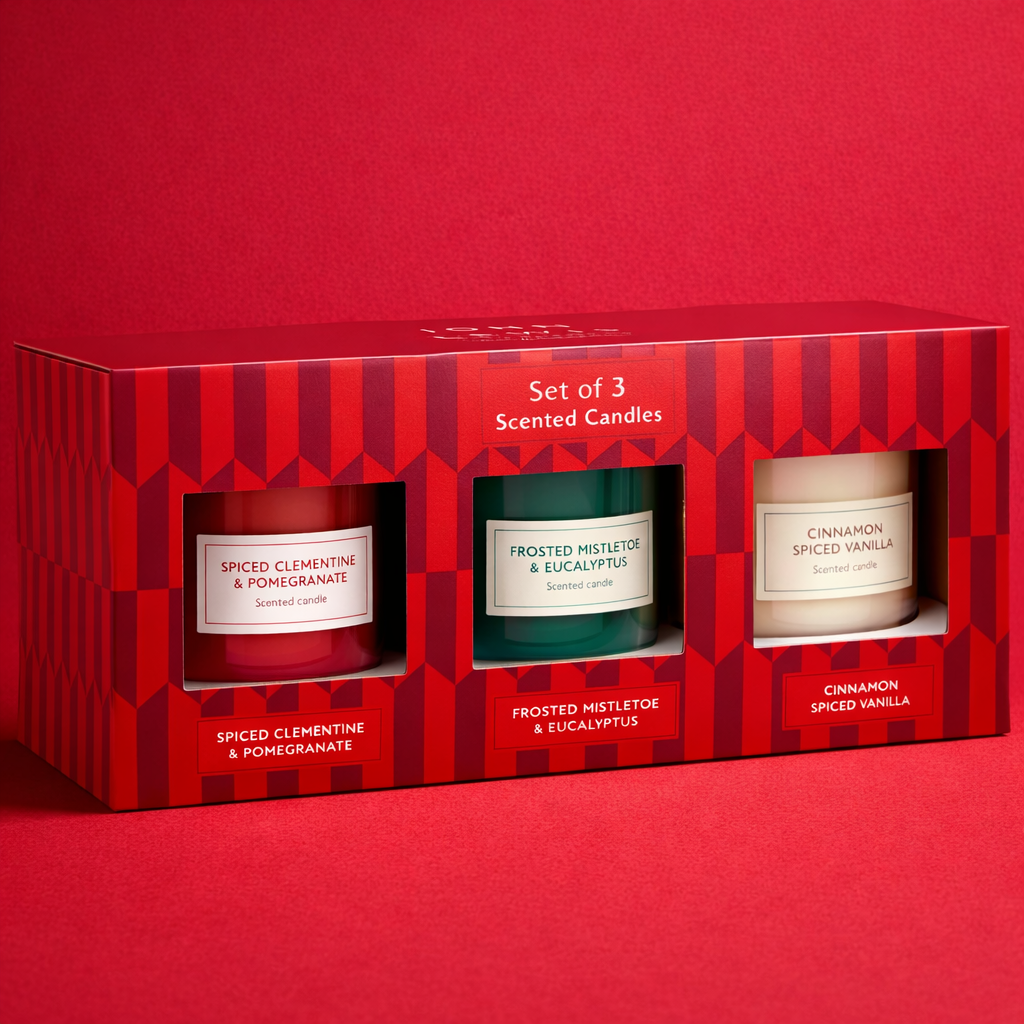
Bundling two or three candles in a purpose-built candle gift box is one of the most effective ways to increase average order value without reformulating your products. A customer who came to buy one $38 candle will often buy a $75 two-pack if the gift presentation is right.
The key is a box that holds the candles securely without movement and looks intentional as a gift from the outside. A drawer-style or two-piece construction tends to work better for gift sets than a tuck-top, because the opening experience feels more deliberate.
Seasonal Packaging
Small runs of seasonal packaging are increasingly accessible at lower quantities. A holiday variant with foil or a special color way, available from October through December, can justify a premium price point and drive gift purchase decisions that a standard run cannot.
The practical constraint is storage. If you are running a small-batch operation, you need to be realistic about how much seasonal inventory you can hold and move before the season ends. Start conservatively on quantities and let your sell-through data guide future seasonal orders.
Display and Wholesale Packaging
If your candles go into retail stores, you may also need display packaging, which is different from individual retail boxes. Candle display boxes are designed to hold multiple units in a shelf-ready configuration, making it easy for a retailer to stock and restock without having to handle individual boxes.
For small businesses breaking into wholesale, display packaging communicates professionalism to buyers. A buyer at a boutique who is considering carrying your line will look at whether your display packaging is retail-ready before they look at much else. It signals that you have done this before, even if you have not.
A simple shelf-ready display box, in the same visual language as your retail packaging, is a worthwhile investment once you have two or three stockists and are actively pursuing more.
Quantity Strategy for Small Businesses
The MOQ conversation is one of the most common pain points for small candle businesses. Here is a practical framework.
Start at 100 to 250 units per SKU. This is enough to validate a design, test your packaging with real customers, and give you data before you commit to a larger run. Expect higher per-unit costs at this quantity, and build that into your pricing model.
Once you have sold through two or three runs and you are confident in the design, step up to 500 units. Per-unit cost drops meaningfully. If you are moving 500 units within two to three months, step up to 1,000 and the economics get significantly better.
The mistake to avoid is ordering 1,000 units before you have validated demand for that particular SKU. Packaging becomes obsolete as brands evolve, and dead stock packaging is a real cost that many small business owners underestimate.
A Note on Packaging and Brand Cohesion
One thing that separates emerging candle brands from established ones is packaging cohesion. When every SKU looks like it belongs to the same family, the brand reads as more mature and trustworthy than a collection of individually designed boxes.
This does not require a large budget. It requires a consistent set of decisions: one or two typefaces, a defined color palette, consistent logo placement, and a consistent dieline family so your 8 oz, 10 oz, and 16 oz boxes share structural proportions.
If you are building your line, making these decisions once, early, is far cheaper than trying to unify packaging across a dozen SKUs that were each designed independently.
When you are ready to think through options and get pricing, request a quote or browse our product range to see what is possible at your stage.