Getting candle box dimensions right is one of the most practical challenges in custom candle packaging, and one where small errors create big problems. A box that is even a fraction of an inch too tight may not close cleanly. A box with too much clearance lets the candle shift in transit, which means rattling during delivery and potential breakage for glass vessels.
This guide covers how to measure your candles accurately, how to calculate box dimensions for a proper fit, and reference dimensions for the most common candle formats on the market. It is a working reference, not a theoretical exercise.
How to Measure Your Candle
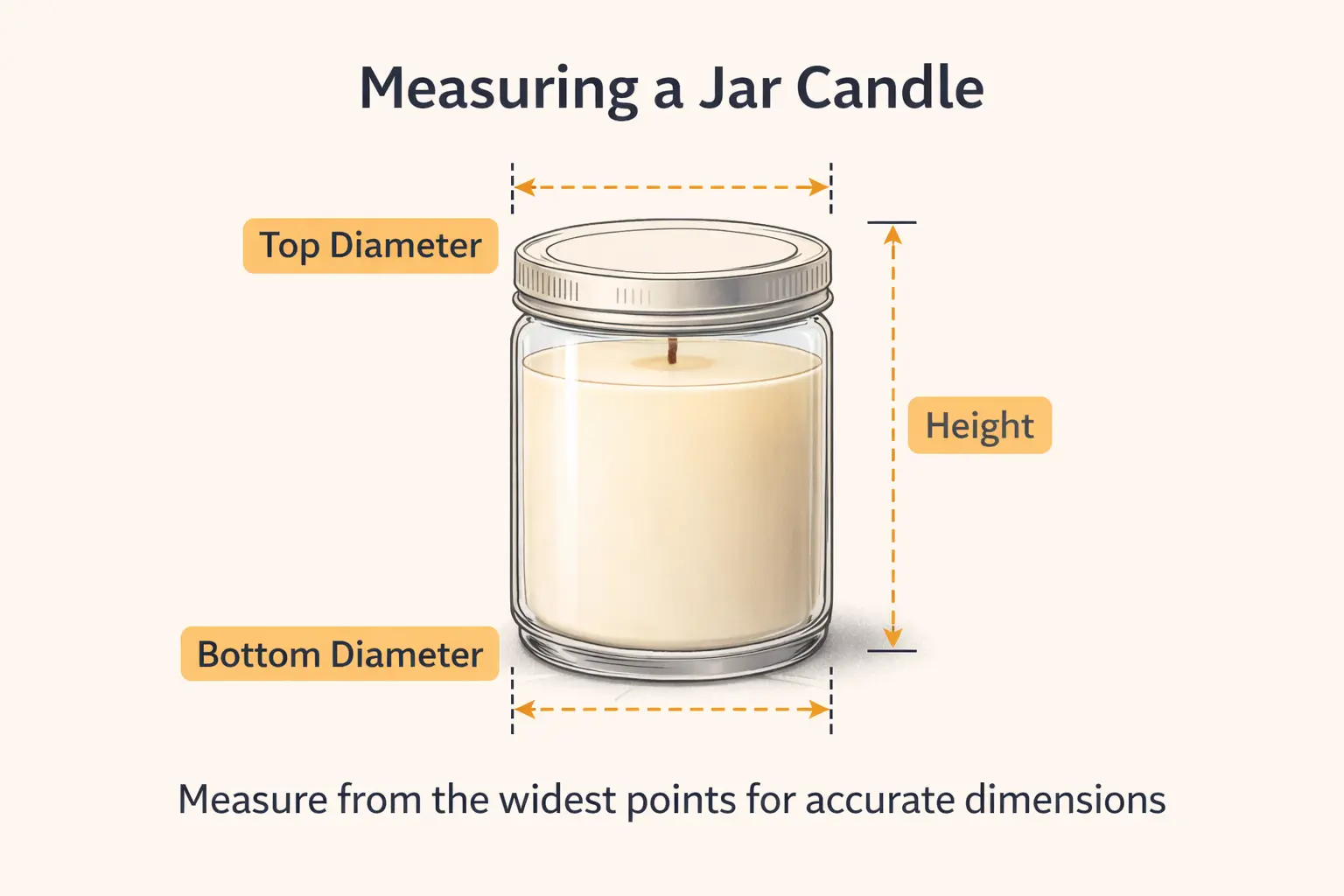
Before you can spec a box, you need accurate dimensions for your product. Measure with a caliper if you have one, or a ruler if you do not. Take three measurements.
Diameter or cross-section: For round jars and tins, measure the widest external diameter of the vessel, including any lip or rim that protrudes. For square or rectangular vessels, measure the widest point on each face.
Height: Measure from the base of the vessel to the top of the lid or cap, whichever is higher. If the candle does not have a lid, measure to the rim.
Lid or cap overhang: Some candle lids have a lip that extends slightly beyond the vessel diameter. Measure this specifically if it exists. This dimension determines whether you need a box designed to accommodate a lid overhang.
Take each measurement at least twice and use the larger reading if they differ. Dimensional variation across a production run is normal, and you want your box to accommodate the largest units, not the average.
Box Dimension Conventions
Box dimensions are always expressed in the same order: Length x Width x Height (L x W x H). Length is typically the longest horizontal dimension, width the shorter horizontal dimension, and height the vertical dimension.
For candle boxes, you add clearance to each vessel dimension to arrive at the interior box dimension. Interior clearance is the gap between the vessel and the interior box wall. Then, the manufacturer adds wall thickness (determined by the substrate caliper) to calculate the exterior dimension.
When you specify a box to a manufacturer, you almost always specify interior dimensions. The manufacturer accounts for wall thickness. Confirm this with your specific supplier, as some quote exterior dimensions.
Standard Interior Clearance
For a snug but non-damaging fit with standard tissue or insert paper:
- Diameter/cross-section clearance: 1/8” to 1/4” (3 to 6 mm) on each side, or 1/4” to 1/2” (6 to 12 mm) total on each dimension
- Height clearance: 3/16” to 3/8” (5 to 10 mm) total, enough to close the lid cleanly without compressing the candle
For products shipped without an outer carton, use the upper end of these clearances to allow for insert paper, foam, or tissue wrap inside the box.
For display packaging where the box will sit on a retail shelf and you want minimal movement, use the lower end.
Reference Dimensions for Common Candle Formats
The following table provides typical vessel dimensions and suggested interior box dimensions for the most common candle formats. Your specific vessel may vary. Always verify against your actual product before submitting a final spec.
4 oz Jar Candles (Typical: small votives, travel candles)
Common vessels in this size include small round candle jars roughly 2-3/8” diameter x 2-1/8” height (60 x 55 mm) and small square glass jars.
Suggested interior box dimensions: 3” x 3” x 2-3/4” (75 x 75 x 70 mm) for a straight-wall round jar in a square box.
If using a window box or the vessel is square, measure the actual vessel width and add 1/4” to 5/16” on each side.
8 oz Jar Candles (Typical: the workhorse single-candle format)
The 8 oz single-wick jar is the most common candle format in the US market. A wide range of vessel shapes exists in this weight class.
Common round vessels: approximately 3-1/8” to 3-1/2” diameter x 3-1/2” to 4” height (80 to 88 mm diameter x 90 to 100 mm height).
Suggested interior box dimensions: 3-7/8” x 3-7/8” x 4-3/8” (98 x 98 x 110 mm), which accommodates most 8 oz round jars including a lid.
Tall, narrow 8 oz formats: measure carefully. Some specialty vessels are taller and narrower (e.g., 2-3/4” diameter x 4-3/4” height) and require a different box proportion.
10 oz Jar Candles
A popular mid-size format, often in the same vessel family as 8 oz with slightly more fill.
Common dimensions: approximately 3-1/2” to 3-3/4” diameter x 4” to 4-3/8” height (88 to 95 mm diameter x 100 to 110 mm height).
Suggested interior box dimensions: 4-1/4” x 4-1/4” x 4-3/4” (108 x 108 x 120 mm)
12 oz Jar Candles
Common in apothecary and specialty brands. Slightly wider vessel or taller fill line.
Common dimensions: approximately 3-1/2” to 4” diameter x 4-3/8” to 4-3/4” height (90 to 100 mm diameter x 110 to 120 mm height).
Suggested interior box dimensions: 4-1/2” x 4-1/2” x 5-1/8” (115 x 115 x 130 mm)
16 oz Jar Candles (Large format)
Large single-wick and multi-wick candles. Vessel dimensions vary significantly by brand.
Common dimensions: approximately 4” to 4-1/2” diameter x 4-1/2” to 5-1/8” height (100 to 115 mm diameter x 115 to 130 mm height).
Suggested interior box dimensions: 5” x 5” x 5-3/4” (128 x 128 x 145 mm)
Heavier vessels in this size class often benefit from a slightly more substantial substrate (higher caliper) to maintain box rigidity when carried.
Round Tin Candles
Tins differ from glass jars in that the exterior profile is more consistent across manufacturers. The lid typically creates the full diameter.
Common sizes:
- 4 oz tin: approximately 2-15/16” diameter x 1-9/16” height (74 x 40 mm). Suggested box: 3-3/8” x 3-3/8” x 2” (86 x 86 x 50 mm)
- 8 oz tin: approximately 3-1/2” diameter x 2-3/16” height (89 x 55 mm). Suggested box: 4” x 4” x 2-9/16” (101 x 101 x 65 mm)
- 16 oz tin: approximately 4-5/16” diameter x 2-11/16” height (110 x 68 mm). Suggested box: 4-13/16” x 4-13/16” x 3-1/16” (122 x 122 x 78 mm)
Tin candles with a slip lid (the lid fits inside the rim rather than over it) require measuring the lid diameter carefully, as the lid may be slightly narrower than the tin body.
Pillar Candles
Pillar candles present more variability than candle jar boxes because the candle itself is the primary display element. Standard pillar dimensions:
- 2 x 3 inch pillar: Suggested box: 2-1/2” x 2-1/2” x 3-1/2” (63 x 63 x 90 mm)
- 3 x 6 inch pillar: Suggested box: 3-1/2” x 3-1/2” x 6-1/2” (90 x 90 x 165 mm)
- 3 x 9 inch pillar: Suggested box: 3-1/2” x 3-1/2” x 9-5/8” (90 x 90 x 245 mm)
Pillar candles are often sold unboxed or with a simple sleeve rather than a full enclosing box. If you do use a full box, the clearance at top and bottom matters more than for a jar, since pillars are typically burned without a lid and the wax surface may be visible.
Taper Candles
Taper pairs are typically boxed as two or four candles. The taper is tall and narrow, so box dimensions are unusual: long and thin.
- 10 inch taper pair: Suggested box approximately 2-3/4” x 1-3/8” x 10-5/8” (70 x 35 x 270 mm) for a snug two-taper package
- 12 inch taper pair: Suggested box approximately 2-3/4” x 1-3/8” x 12-13/16” (70 x 35 x 325 mm)
These dimensions accommodate the tapers lying flat in a slim box. Some brands use a wider box with a custom insert to hold the tapers vertically.
Multi-Candle Gift Sets
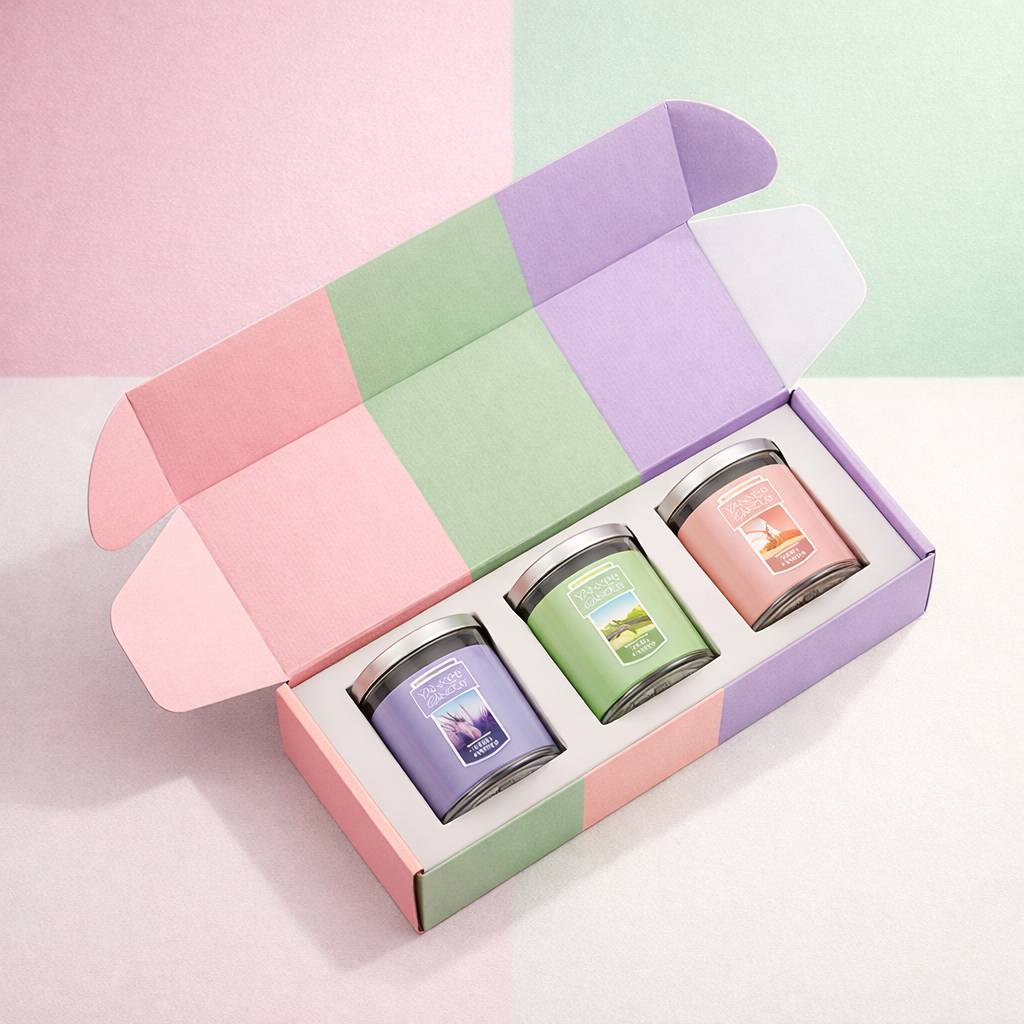
For candle gift boxes holding two or more candles, the sizing approach is the same but you need to account for both the combined vessel footprint and the internal structure that separates and holds the candles.
For a two-candle set using 8 oz round jars:
- Two jars side by side: approximately 6-15/16” x 3-7/8” footprint (176 x 98 mm), based on two 3-1/2” diameter jars with minimum clearance
- Suggested interior box: 7-1/2” x 4-3/8” x 4-3/4” (190 x 110 x 120 mm) with a central cardboard divider
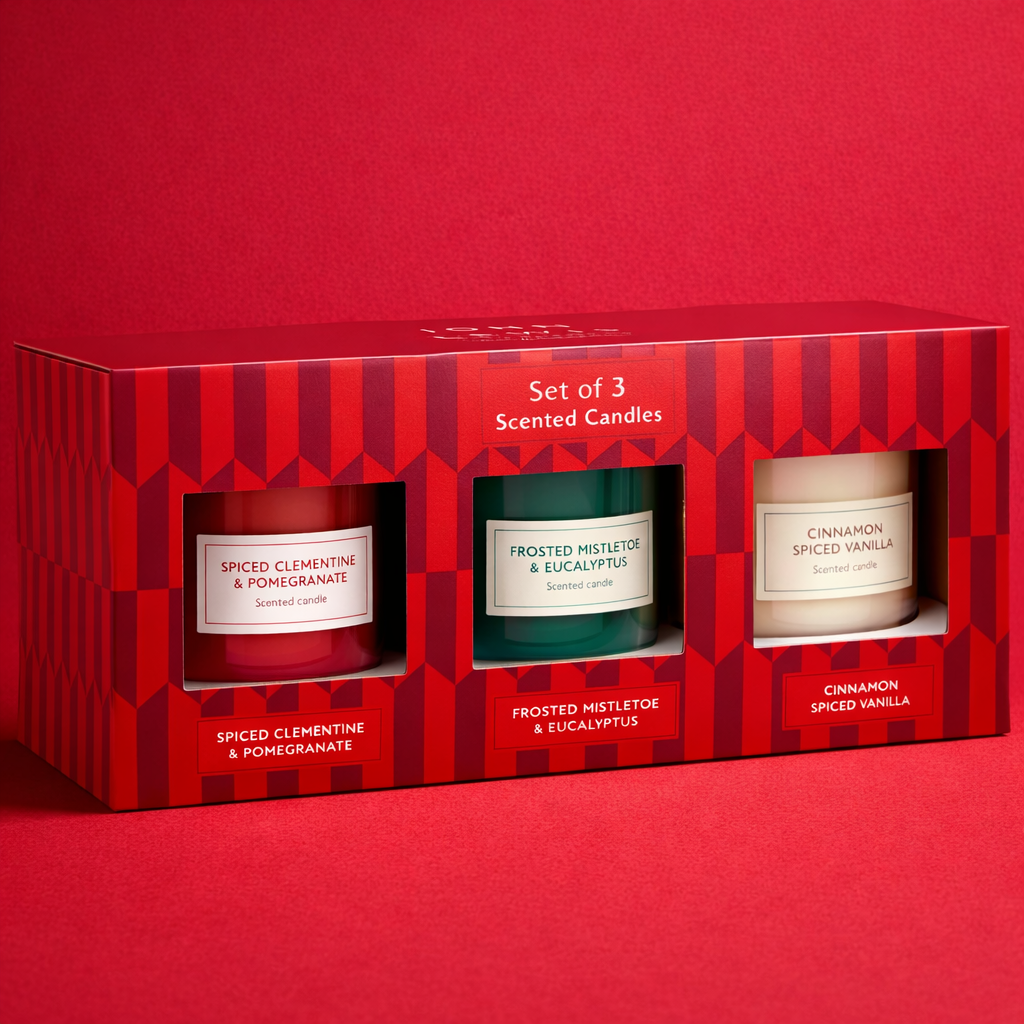
For a three-candle set using 8 oz round jars arranged in a triangle or row:
- Row arrangement: approximately 10-3/8” x 3-7/8” footprint (264 x 98 mm)
- Triangle arrangement: approximately 6-15/16” x 6-1/2” footprint (176 x 165 mm), slightly more compact but requires a specific insert
Gift sets benefit from a custom foam or cardboard insert that holds each candle in position. Without an insert, candles will move in transit and may damage each other’s labels or lids.
Subscription Box Dimensions
Candle subscription boxes typically ship a consistent format every cycle, which means the box dimensions are fixed to the subscription’s standard candle size. If your subscription includes a mix of sizes, the box is usually sized to the largest format with inserts to accommodate smaller formats.
For a monthly subscription shipping one 8 oz jar candle plus accessories (matches, care card, tissue):
Suggested corrugated mailer interior: 7-1/2” x 6-5/16” x 5-1/8” (190 x 160 x 130 mm). This provides room for the candle, a layer of tissue, and small accessories alongside without excessive movement.
For a two-candle monthly subscription (two 8 oz jars plus accessories):
Suggested corrugated mailer interior: 11-3/8” x 6-5/16” x 5-1/8” (290 x 160 x 130 mm). This holds the two jars side by side with a divider insert.
Tolerances and Production Variation
A few practical notes on tolerances that often catch brand owners off guard.
Box manufacturing tolerance: Cardboard boxes typically have a manufacturing tolerance of plus or minus 1/16” (2 mm) on any given dimension. If you spec a box at exactly your minimum clearance, some units will be tight and a small number may not close properly. Build in at least 5/32” (4 mm) of clearance on each constrained dimension to stay well inside tolerance.
Vessel production variation: Glass and tin vessel dimensions vary by production batch. The nominal diameter of a jar may be 3-1/2” (88 mm) but individual units may range from 3-7/16” to 3-1/2” (87 to 89 mm). If you are changing vessel suppliers or working with a new manufacturer, re-measure before assuming previous box specs still apply.
Seasonal dimension drift: Glass vessels, particularly thin-wall glass, can have slight dimension variation between production runs due to mold wear. If you have been using a box spec for two or three years and are suddenly seeing fit issues, it is worth remeasuring your current vessel stock.
Working With a Manufacturer on Dimensions
When you bring dimensions to a packaging manufacturer, the process typically works as follows.
You provide your vessel dimensions (or interior box dimensions if you have calculated them yourself). The manufacturer draws a structural dieline based on your dimensions and the chosen box style. You review and approve the dieline, ideally with a physical blank sample before final print.
Most manufacturers will catch obvious dimension errors during the dieline stage. However, they will not have your actual vessel to test-fit. The responsibility for providing accurate vessel dimensions sits with you.
If dimensions are even slightly off and you catch it in dieline review, correction is a simple file update. If you catch it after a production run, you have a problem.
The safest approach for a new box spec: request a blank prototype die-cut in the correct material before committing to a print run. A few days of lead time at this stage can save you from a costly correction later.
If you are ready to work through dimensions and get pricing for your specific candle format, get a quote or browse our full packaging catalog to identify the right structure for your product.